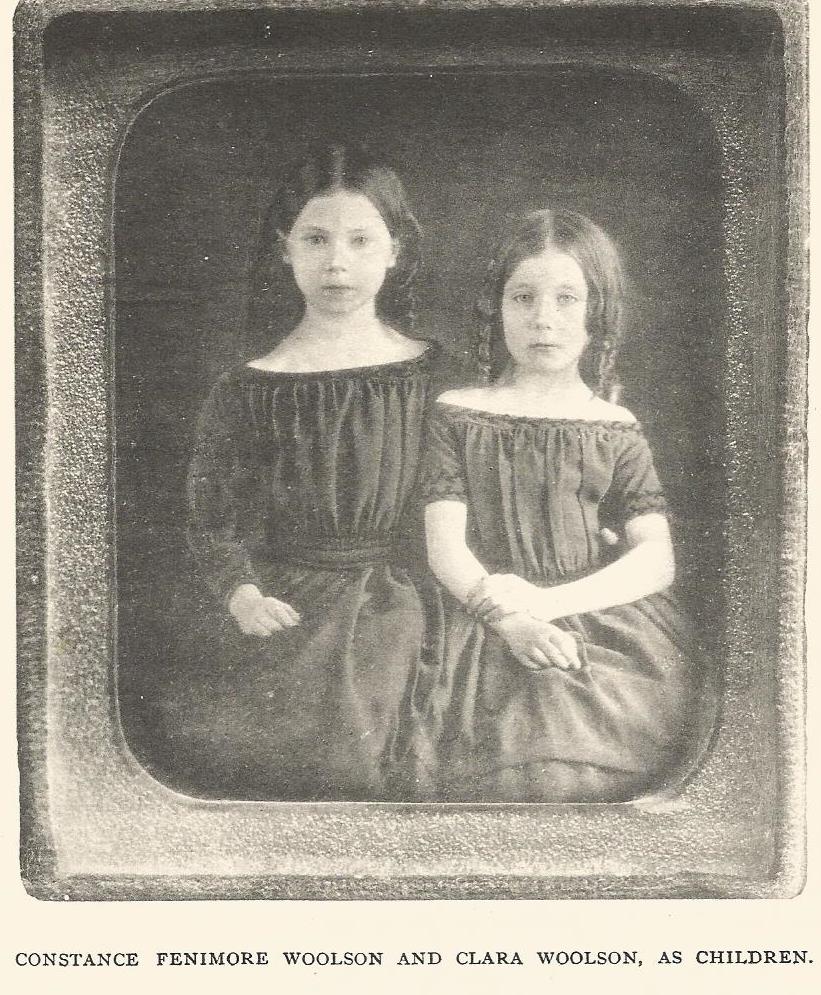
Although Constance Fenimore Woolson was born in New Hampshire in 1840, she did not live there long. Shortly after her birth, three older sisters died of scarlet fever and Woolson’s family moved to Cleveland, Ohio, to start over. She grew up in what was then known as the Old Northwest Territories, watching as the Great Lakes region became the industrial heart of the United States.
Woolson set her early fiction, poetry, and travel narratives on the Lakes’ frontier, then moved to the South after the Civil War to explore another region with different cultural conflicts. Later, she moved to Europe where she scrutinized the wealthy American expatriate communities on the Continent. Although her work can be loosely divided into three periods that correspond with the three regions she described, several life-long concerns informed her writing from the outset: the role of the artist in a market-driven economy, the restrictions placed on women and particularly women artists, environmental destruction, the complexities of race and class, and the responsibilities of wealth. As a women, however, she was prevented from commenting directly on controversial subjects such as nineteenth-century financial panics, interracial marriage, mixed-race children, post-Civil War monetary arguments, and poor political leadership. Her solution was to surreptitiously weave references to contested subjects into her fiction, poetry, and travel narratives that astute readers would recognize, thus letting her participate in the political and cultural debates of her time while still retaining her reputation as a “lady” who was a respected artist. This method allowed her to refer to the environmental destruction of the old-growth forests of the Great Lakes region, religious hypocrisies, legal cases eviscerating the rights of newly enfranchised freed people after the Civil War, prejudice against LGBT and mixed-race people, the unjust machinations of male editors, unrepentant southern apologists, and Americans in Europe flaunting their wealth. Had she addressed these themes directly, her work would never have been published, but by using names, dates, art, music, and biblical references, Woolson could escape the conventions imposed on her gender and participate in the political and social discussions usually reserved for men. This technique sets her work apart from her contemporaries, both men and women, and requires that any Woolson text be read on two levels: the surface story, which is usually wonderfully compelling and beautifully written, and the subtextual political or cultural commentary she was making, often satirically.
Beginning Her Career
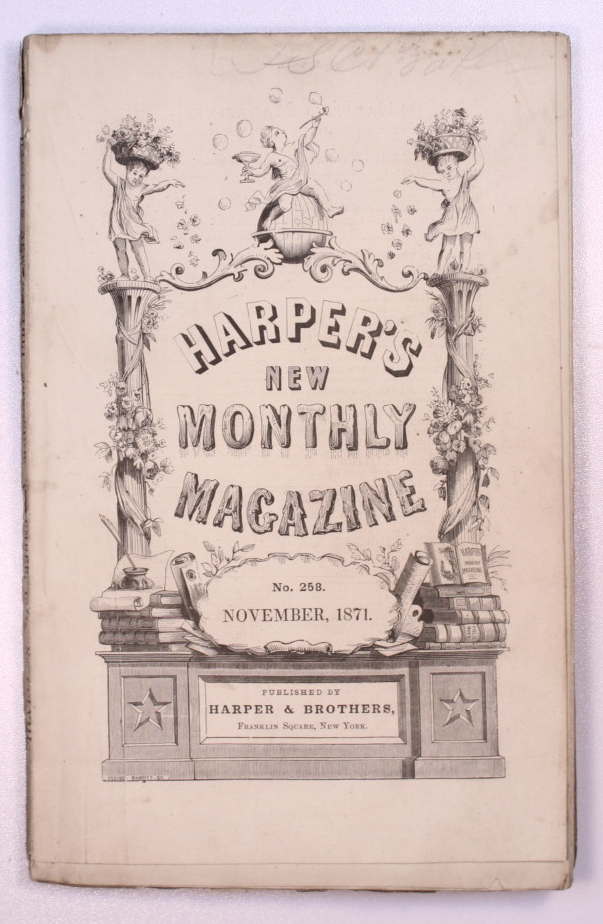
Woolson needed money after the her father’s death in 1869 left her and her mother with too little income to live comfortably. A gifted writer, she had little trouble establishing herself in the literary world, capitalizing on her middle name to gain the attention of publishers who also recognized her talent. She placed her earliest sketches, short stories, and travel narratives in some of the best periodicals of the time, such as Harper’s New Monthly Magazine, The Atlantic Monthly, and Appletons’ Journal. While she wrote some early pieces that were like the then-popular sentimental sketches, literary fashions soon began to change to post-Civil War realism. She also decided to become a serious artist exploring difficult subjects rather than a genteel storyteller. “Local color” stories about curious characters in remote places, a type of fiction championed by William Dean Howells, the influential editor of The Atlantic, allowed readers to travel vicariously through the expanding United States. Woolson employed this fictional method to place stories and be well paid for it, but she also used it to refer referentially to her political agendas, sometimes under the noses of her unsuspecting editors.
For example, “Peter the Parson,” a story set in a Lake Superior mining camp that is often read as realistically portraying frontier brutality, is also Woolson’s castigation of a schism in the Episcopal Church between the ritualists and the evangelicals about which women were forbidden to speak publically. To make certain readers recognized her satire, she quoted from church materials and referred to a seminary by name, before killing symbolic representatives of both factions: her retort to the silencing of women members of the church. “Mission Endeavor,” which appears to describe a Protestant mission to the Natives on Lake Superior, is her sarcastic comment on a nineteenth-century mania called the Palestine Return, which believed that only when the Jews returned to Palestine and everyone there had been converted to western-style Christianity could the second coming of Christ take place, preferably before the millenium in 1900. Melville and Twain also wrote about the Palestine Return, and Woolson’s judgments were no less deploring than theirs. Hypocrisy and prejudice, environmental destruction, and arrogance never failed to elicit her satires, many of which went unrecognized after the beginning of the twentieth century.
Although both her stories and travel narratives were written for sophisticated literary magazines that catered to an educated and often prosperous bourgeoisie, Woolson’s experiments with realism and her subtextual references were still courageous. But because she was self-supporting, she also wrote stories, travel narratives, and poetry that would appeal to all the readers in her audience. Thus, her work ranged from deliberately charming travel narratives such as “American Cities: Detroit” (1872), which described Detroit as it had not been in a hundred years but which her readers preferred to the contemporary reality, to broadly humorous satires such as “Round By Propeller” (1872) for Harper’s that reminded readers of slavery, mocked the Great Lakes travelers she described, mocked her readers, and left no questions about what Woolson thought of the transformation of the once-pristine Great Lakes that had been clear-cut and industrialized. As she would throughout her career, she constantly pushed at the limits of what was acceptable for a writer, and a woman, to publish, and then went beyond the acceptable with her subtextual references.
Moving South
In 1873, Woolson moved with her invalid mother to St. Augustine, Florida. This small city had been colonized by Spain in the seventeenth century, the same period that the Great Lakes were being colonized by the French. Once again Woolson found herself on a frontier, a borderland between cultures. This time, however, the cultural issues were not industrialization and environmental destruction, but the Reconstruction South that was struggling to survive in the aftermath of the Civil War and the freeing of slaves. Even as she completed her narratives of the Great Lakes, Woolson began to catalog the conflicted landscapes being negotiated between the traditions of the Old South just destroyed and those of the New South being born, including wealthy tourists from the North and carpetbaggers intent on profiting from others’ losses. Once again she was a pioneer, not only because she wrote the first Reconstruction fiction by a northerner after the War, but also because she early articulated cultural tensions that would not be resolved in her lifetime or the present. She had been a social justice fighter from the beginning of her carrer, inserting references to national decisions on slavery in her Great Lakes stories, and she continued this practice with the work she set in the South.
In stories like “Rodman The Keeper” (1877) and travel narratives like “The Ancient City” (1874), Woolson described for northern readers the charming and beautiful aspects of a Florida most had never seen, but she also explored the sectional and racial tensions experienced by those who lived there. She also returned to the theme of mixed-race people, which she had portrayed earlier with “Jeannette,” set on Mackinac Island, and “Wilhelmina” set in Ohio, by introducing her readers to the Minorcans of Florida in stories such as “Felipa” (1876) and “Miss Elisabetha” (1875). Her portrayals of post-Civil War race relations has sometimes been interpreted as critiquing the possibilities for African-American education and citizenship, particularly in her most controversial story, “King David” (1878), but that reflects readings that missed or ignored her references which were pointed about the failures of missionairies, carpetbaggers, and northerners ignoring their complicity in slavery. In “King David,” she described how northern missionaries attempted to impose their values on the South in a kind of imperial fantasy of spreading civilization to a backward region, but the African-American freedman gets the last word, claiming the right to lift himself up rather than be lifted by whites. Other stories—“Rodman The Keeper,” “In the Cotton Country” (1876), “Old Gardiston” (1876)—examine the lingering tensions between northerners and southerners in a devastated region, arguing for compassion and understanding from both sides of the conflict both had endured. At the end of “Rodman,” the northern cemetery keeper tells the defiant, poverty-stricken southern belle, ”Follow your path out into the world. Yet do not think, dear, that I have not seen—have not understood.”
The tense climate of the post-Reconstruction United Sates made it difficult for Woolson to write directly about controversial issues, however. Indeed, one of the Harper brothers told her in 1876 that she should stop writing about the Civil War entirely, supposedly because it annoyed readers who wished to move on. This led Woolson to continue encoding references to race and to the War, but she was sometimes so circumspect that readers missed her point completely. Thus, while her novella For the Major (1883) appears to be about the relationship between a ideally genteel southern woman and her elderly ex-Confederate husband in a small southern community, Woolson’s subtext has detailed references to slavery, interracial marriage, mixed-race children, U.S. Supreme Court cases, and Congressional legislation. She had written subversively about these themes before in “Mrs. Edward Pinckney,” a story set in Arlington National Cemetery to protest Virginia laws about mixed-race marriage, but the national legal cases that were continuing to eviscerate the rights of non-white people apparently enraged her, so even after moving to Europe and beginning to concentrate on the problems experienced by women artists, she returned to the subjects of race and the War to create the seemingly sentimental novella For the Major, fooling critics for more than a century who fell for the charming southern woman protagonist who created a fantasy readers wanted to believe while she hid her past and tried to protect her mixed-race son.
European Experiments
After her mother’s death in 1879, Woolson was finally free to travel to Europe, which she had longed to do since she was a child. She would spend the rest of her life there, alternating between England and Italy and journeying to cosmopolitan spas and tourist destinations in France, Switzerland, and Germany, all the while observing and recording the vagaries of the American expatriate community. After perfecting her craft analyzing the Great Lakes frontier and the Reconstruction South, Woolson had a prescient eye for the conflicts arising in transitional cultures, and Americans abroad offered her a new cultural geography to explore and satirize.
Unimpressed by wealth and social position, and becoming increasingly frustrated by the condescension women artists were forced to endure, Woolson began the third and last period of her career with her most anthologized story, “‘Miss Grief’” (1880). This story of a woman writer encapsulated the frustrations she felt as male writers garnered more serious, but not necessarily more deserved, attention. Never out of print since its publication in 1880, “‘Miss Grief’” is a tour-de-force rendering of the status of women of genius in the late nineteenth century and the failure of powerful male literary figures to recognize women’s brilliance and potential. No short story by any contemporary of Woolson expresses so well the double bind of the woman artist, which explains its continuing popularity.
Even while creating three novels exploring the problems that could be encountered in marriage, including wife-battering and infidelity, Woolson continued to produce short stories and travel narratives, and many of these are her most polished work, produced by an artist sure of her medium. Woolson’s European writings, many written during the Gilded Age, often critiqued Americans’ willful ignorance about what was already an international world. In several stories she created a disturbing foreshadowing of the self-satisfied imperialism that would mark American attitudes before World War I. “Dorothy” (1892), nominally a romance, critiqued not only the ignorance of doctors about the relationship between grief/depression and physical illness, but also British and American imperialism in Egypt and the dangers that might ensue from the immenent collapse of the Ottoman Empire. In “A Waitress,” published posthumously, she chastised complacent Americans and British who did not understand the potential changes populist politics can engender, referring not only to the Resorgimento in Italy, but also, satirically, to the misguided German emperor who would precipatate World War I after Woolson’s death. In this story, as in so many others, her cultural and political visions were prescient.
Because Woolson trained herself to be unsparing in her critiques of the Great Lakes frontier, she was able to elucidate the problems of all the other nineteenth-century frontiers she observed: racial relations, the land and environment, business and industry, monetary policies, and American consumption of cultures and places. She watched the country change from frontier agrarianism, to small towns, to industrialized cities, and from a collection of local cultures to an international one. She observed Americans making the same mistakes on Lake Superior or in Venice: the failure of love and trust, condescension, sexism, greed, racism, and hatred. Even as her early work set on the Great Lakes looks back with some nostalgia to what she knew was a mythical frontier, her final stories look forward to an international one Americans were ill-prepared to understand or accept.
Victoria Brehm
 Constance Fenimore Woolson