Sharon Dean and Gary Woolson
Harper’s (no italics) refers to the publishing company Harper & Bros. Harper’s refers to Harper’s New Monthly Magazine.
1840: Woolson born March 5 in Claremont, New Hampshire, the fifth daughter of Charles Jarvis Woolson (1806-1869) a stove manufacturer, and Hannah Cooper Pomeroy Woolson (1808-1879), who married in 1830. Between March 21 and April 3, sisters Julia (2), Gertrude (4) and Ann (5) die from scarlet fever. In winter, Constance moves with her parents and sisters Georgiana (9) and Emma (7) to Cleveland, Ohio, stopping first in Cooperstown, New York, to visit Cooper relatives.
1840s: Sister Clara born (1843-1923). Sister Alida born (1845-1846). Brother Charles Jarvis, Jr. born (1846-1883). In the late 1840s Constance attends Miss Hayden’s school in Cleveland.
1850s: Attends Cleveland Female Seminary. In 1850, Sister Georgiana marries Samuel Livingston Mather (1817-1890). Their son, Samuel Mather, Jr., is born in 1851. He will die in 1931. Sister Emma marries Reverend Timothy Carter, who dies the same year. Emma dies in1852. Katherine Livingston Mather is born in 1853 and Georgiana dies from tuberculosis the same year. The Woolson family begins summer visits to Mackinac Island, Michigan. Their visits to Wisconsin and to the Zoar Community in Ohio likely occur in the 1850s. Constance graduates from Madame Chegaray’s School, New York City in 1858.
1861-66: Constance works for the Union cause during the Civil War, spending part of her time in New York and part in Cleveland.
1867: Sister Clara marries George Stone Benedict.
1868: Clare Benedict, Woolson’s biographer, is born in Cleveland.
1869: Charles Jarvis Woolson, Sr. dies, possibly of a heart condition.
1870-71: George Benedict killed in a train crash February 6, 1871. Before that tragedy, Woolson spends time in Cleveland, with relatives in Cooperstown, and in New York City where she stays at 49 West 32nd Street. Publishes sketches: “The Happy Valley” (Harper’s, July 1870); “Fairy Island” (Putnam’s, July 1870), “The Haunted Lake” (Harper’s, Dec. 1871). Publishes essays: “Spots” (Lippincott’s, May 1871), “Extremities. The Head and Hands” (Harpers Bazar, Oct. 21, 1871), “Extremities. The Feet” (Harper’s Bazar, Nov. 21, 1871). Publishes a poem: “Charles Dickens. Christmas, 1870” (Harper’s Bazar, Dec. 31, 1870). Publishes stories: “An October Idyl” (Harper’s, Nov. 1870), “A Day of Mystery” (Appletons’ Sept. 9, 1871), “Cicely’s Christmas” (Appletons’ Dec. 30, 1871). Begins publishing “New York: From Our Special Correspondent” and “Letters from Gotham” in George Benedict’s Daily Cleveland Herald (Dec. 24, 1870, Jan. 10, 1871, Jan. 14, 1871, Jan. 21, 1871, Jan. 28, 1871, Feb. 4, 1871).
1872: Woolson lives in Cleveland at 131 St. Clair St. Publishes travel narratives: “In Search of the Picturesque” (Harper’s, July), “American Cities–Detroit” (Appletons’, July 27), “Round by Propeller (Harper’s, Sept.). Publishes poems: “The Herald’s Cry” (Lippincott’s, Jan.), “Walpurgis Night” (Old and New, Jan.), “A Merry Christmas” (Jan.), “Love Unexpressed” (Appletons’, March 9), “The Heart of June” (Galaxy, June), “Longing” (Appletons’, June 22), “Off Thunder Bay” (Harper’s, July), “Corn Fields” (Harper’s, Aug.), “Floating. Otsego Lake, September, 1872” (New York Evening Mail, Sept. 14), “Ideal. (The Artist Speaks.)” (Atlantic, Oct.), “October’s Song” (Harper’s, Oct.), “Lake Erie in September” (Appletons’, Oct. 12), “Christmas in the City” (Appletons’ Dec. 28). Publishes stories: “A Merry Christmas” (Harper’s, Jan.), “Margaret Morris” (Appletons’ (Apr. 13), “Weighed in the Balance” (Appletons’, June 1), “One Versus Two” (Lippincott’s, Aug.), “Lily and Diamond” (Appletons’, Nov. 2).
1873: Lives at 131 St. Clair Street in Cleveland and at 61 West 17th Street in New York City with trips to Cooperstown. She wins a thousand-dollar prize from D. Lothrop & Co. for The Old Stone House, a novel for children. Publishes several travel narratives: “The Wine Islands of Lake Erie” (Harper’s, June), “Mackinac Island” (Appletons’, March 8; Appletons’ Picturesque America, vol. 1), “The Bones of Our Ancestors” (Harper’s, Sept.), “Lakeshore Relics” (Lippincott’s, Nov.), “Lake Superior” (Appletons’ Picturesque America, vol. 1), “The South Shore of Lake Erie” (Appletons’ Picturesque America, vol. 1). Publishes poems: “Commonplace” (Lippincott’s, Feb.), “February” (Appletons’, Feb. 8), “March” (Harper’s, March), “The Greatest of All is Charity” (Harper’s Bazar, Feb. 8), “Two Ways” (Ohio Farmer, Apr. 12, The Atlantic, June), “Heliotrope” (Harper’s, July), “Sail-Rock, Lake Superior” (Appletons’, July 12), “Kentucky Belle” (Appletons’, Sept. 6), “Hero Worship” (Harper’s, Oct.), “Cleopatra” (Appletons’, Oct. 4), “Memory” (Appletons’, Nov. 8), “The Haunting Face” (Appletons’, Dec. 6). Publishes stories: “King Log” (Appletons’, Jan. 18), “On the Iron Mountain” (Appletons’, Feb. 15), “Ballast Island” (Appletons’, June 28), “Solomon” (Atlantic, Oct.), “St. Clair Flats” (Appletons’, Oct. 4).
1874: Travels with her mother to St. Augustine, Florida, by April, where she meets Edward C. Stedman and begins a correspondence with him. She writes to William Dean Howells about her first submissions to The Atlantic Monthly. Begins serious study of ferns. She and her mother travel, via Charleston, South Carolina, to Asheville, North Carolina, in June. Briefly leaves her mother there for a trip to New York. Remains in Asheville until October, then returns via Chattanooga, Tennessee, and Atlanta, Georgia, to St. Augustine, stopping along the way at various Civil War battlefields, a habit she continues throughout her time in the South. Publishes travel narratives: “A Voyage to the Unknown River” (Appletons’, May 16); The Ancient City I & II serialized in Harper’s (Dec. 1874-Jan. 1875). Publishes essay “Euterpe in America (Lippincott’s, Nov.). Publishes poems: “Yellow Jessamine” (Appletons’, March 21), “Dolores” (Appletons’ (July 11), “At the Smithy” (Appletons’, Sept. 5), “The Florida Beach” (Galaxy, Oct.), “Indian Summer” (Appletons’, Oct. 17), “Pine-Barrens” (Harper’s, Dec.), “Matanzas River” (Harper’s, Dec.). Publishes stories: “A Flower of the Snow” (Galaxy, Jan.), “The Story of Huron Grand Harbor” (Appletons’, Apr. 18), “Misery Landing” (Harper’s, May), “The Waldenburg Road” (Appletons’, July 4), “Duets” (Harper’s, Sept.), “Peter the Parson” (Scribner’s, Sept.), “The Lady of Little Fishing” (The Atlantic, Sept.), “Jeannette” (Scribner’s, Dec.), “The Old Agency” (Galaxy, Dec.).
1875: Woolson begins correspondence with poet Paul Hamilton Hayne, whom she never meets in person. Winters in St. Augustine, then stays in Charleston in April and May, in Cleveland Springs, Shelby, NC, in June and July, and in Goshen, Virginia, in August and September. Returns via Charleston to St. Augustine, arriving there in December. Visits the Greenbriar at White Sulphur Springs in West Virginia, and stops at Harper’s Ferry in late August or early September. Osgood publishes her first collection of stories as Castle Nowhere: Lake Country Sketches (“Castle Nowhere,” “Peter the Parson,” “Jeannette,” “The Old Agency,” “Misery Landing,” “Solomon,” “Wilhelmina,” “St. Clair Flats,” “The Lady of Little Fishing”). Publishes travel narratives: “The French Broad” (Harper’s, Apr.), “Up the Ashley and Cooper” (Harper’s, Dec.). Publishes essay “Southern Men and Women” (Cleveland Herald, Rpt. New York Times, July 31. Publishes poems: “The Legend of Maria Sanchez Creek” (Harper’s, Jan.), “A Fire in the Forest” (Appletons’, Dec. 4). Publishes stories: “Wilhelmina” (Atlantic, Jan.), “Miss Elisabetha” (Appletons’, March 13).
1876: Spends time in St. Augustine in January and February, then travels in April via Savannah to Summerville, SC where she stays into May. Travels north to Cooperstown for first visit in three and a half years. Leaves Cooperstown in October or November, stopping in Wilmington, NC in November and December. Publishes travel narratives: “The Oklawaha” (Harper’s, Jan.); “Lake Superior” (Picturesque America, vol.1), “Mackinac” (Picturesque America, vol. 1), “The South Shore of Lake Erie” (Picturesque America, vol 1), “On the Ohio” (Picturesque America, vol. 2). Publishes poems: “On a Homely Woman, Dead” (Appletons’, Apr. 1), “Tom” (Appletons’, May 20), “To George Eliot” (The New Century for Woman, May 20), “Only the Brakesman” (Appletons’, n.s., July), “Forgotten” (Harper’s, July), “To Jean Inglow” (The New Century for Woman, July 8), “Four-Leaved Clover” (Harper’s Bazar, July 8), “On the Border” (Appletons’, n.s., Sept.), “Morris Island” (Appletons’, n.s., Dec.). Publishes stories: “Crowder’s Cove” (Appletons’, March 18), “Old Gardiston” (Harper’s, Apr.), “In the Cotton Country” (Appletons’, May 20), “Felipa” (Lippincott’s, June), “Mission Endeavor” (Harper’s, Nov.), “The Old Five” (Appletons’, n.s. Nov.).
1877: In January and February, Woolson writes from St. Augustine to nephew Sam Mather expressing worry about brother Charly’s emotional health; conceals this worry from her mother. Spends much of the year in Yonkers, NY, where sister Clara has a house. Enjoys visits in NY with E. C. Stedman and his wife. Writes frequently to noted botanist, D. C. Eaton about collecting ferns. Publishes reviews in Contributors’ Club section of The Atlantic: Mercy Philbrick’s Choice (May), That Lass o’ Lowrie’s (Sept.) Samuel Brohl et Cie (Nov.). Publishes poems: “Two Women. 1862” (Appletons’, n.s., Jan. & Feb.), “Mizpah. Genesis 31.49” (Appletons’, n.s., June), “‘I, Too!’” (Appletons’, n.s., Sept.). Publishes stories: “Rodman the Keeper” (Atlantic, March), “Sister St. Luke” (Galaxy, Apr.), “Keller Hill” (Appletons’, n.s., May), “Barnaby Pass” (Harper’s, July), “Raspberry Island. Told to me by Dora” (Harper’s, Oct.).
1878: Spends January through May in St. Augustine and Hibernia, FL, then her whereabouts are unknown, perhaps in Yonkers with mother and sister Clara. Begins work on first novel, Anne. Publishes essays and reviews for The Atlantic Monthly’s Contributors’ Club: “Comparison of Prose and Poetry” (June), “Farjeon” (July), “South Carolina Gentleman” (Aug.), Esther Pennefather (Oct.). Publishes poems: “To Certain Biographers” (Appletons’, n.s., Sept.), “An Intercepted Letter” (Harper’s Bazar, Sept. 7), “In Remembrance” (New York Evening Post, Oct. 18). Publishes stories: “Matches Morganatic” (Harper’s, March), “King David” (Scribner’s, Apr.), “Up in the Blue Ridge” (Appletons’, n.s. Aug.), “Bro” (Appletons’, n.s., Nov.).
1879: Leaves Yonkers in January. After the death of her mother on February 13, spends March in Washington, D.C. Sails in November on the Steamship Gallia for Europe via Queenstown, Ireland, and Liverpool. Enjoys museums and cathedrals of London despite the cold weather, then travels to Mentone, France, stopping for only a day in Paris. Begins correspondence with John and Clara Hay. Stops publishing poetry and publishes fewer travel narratives, concentrating on short fiction and novels. Publishes reviews in The Atlantic Monthly’s Contributors’ Club: (The Europeans, Jan. and Feb.), L’Idée de Jean Têterol (Feb.), Far from the Madding Crowd (Feb.). Publishes biographical essay: “Henry Middleton: President of the First Continental Congress,” (Pennsylvania Magazine of History and Biography, vol 3. no. 1). Publishes stories: “Miss Vedder” (Harper’s, March), “Black Point” (Harper’s, June), “Mrs. Edward Pinckney” (The Christian Union, Aug. 6).
1880: Spends January to March in Mentone, then spends late March to May in Florence, where she meets Henry James and explores art treasures with him. Spends part of June in Venice, then travels to Switzerland, staying in Lucerne in July and August and in Geneva in the fall. Returns to Florence by December. Writes her concerns to Sam Mather about brother Charly’s desire to invest in California land. Publishes collection Rodman the Keeper: Southern Sketches with Appletons’ (“Rodman the Keeper,” “Sister St. Luke,” “Miss Elisabetha,” “Old Gardiston,” “The South Devil,” “In the Cotton Country,” “Felipa,” “’Bro,’” “King David,” “Up in the Blue Ridge”). Begins serialization of novel Anne in Harper’s (Dec. 1880-May 1882). Publishes travel narrative “Pictures of Travel: The Last Summer of the St. Gotthard” (The Christian Union, Sept. 1). Publishes stories: “’Miss Grief’” (Lippincott’s, May), “A Florentine Experiment” (The Atlantic, Oct.), “The Old Palace Keeper” (The Christian Union, Oct. 14).
1881: Leaves Florence for Sienna in January, then spends the remainder of January through May in Rome. Returns to Switzerland in July and August, where she drafts “At the Château of Corinne” (Harper’s 1887). Spends time in Geneva, Engelberg, and Lucerne. Travels through Turin, Milan, Padua, Venice, Florence, Rome, and Naples, arriving in Sorrento by December. Whereabouts unknown for the remainder of the year, but probably in Switzerland and Italy. Works on the serialization of Anne, so publishes only one other piece, the travel narrative: “The Roman May, and a Walk” (The Christian Union, July 27).
1882: Spends January into April in Sorrento where she enjoys a visit from nephew Sam Mather and his new wife Flora Stone Mather; visits Paestum and Salerno with them. Returns to Florence in May and then to Baden-Baden, where she writes for an uninterrupted six weeks. Visits Dresden at the end of August and Cologne in September. She arrives in London in September and remains there the rest of the year. Begins serialization of novel For the Major (Harper’s, Nov. 1882 to Apr. 1883). Publishes stories: “In Venice” (The Atlantic, Apr.) and “The Street of the Hyacinth” (Century, June).
1883: Spends time in Paris in late 1882 or early 1883, where she goes to the theater with geologist Clarence King. Arrives in Florence in January, where she sees William Dean Howells and meets Vernon Lee. In April, she flees the society of Florence for Venice, where she lives in an apartment in the Gritti Palace above John Addington Symonds. Leaves Venice for Engelberg and Baden-Baden in July and August and arrives in London late in the year. Brother Charly commits suicide in Los Angeles, California, on Aug. 20. For the Major continues serialization in Harper’s and book version appears (Harper’s). British company Sampson and Low publishes Anne and For the Major. Works on travel narrative “At Mentone.”
1884: Lives at Sloane St., London, where she is ill for three months, partially because she is mourning suicide of her brother. In June or July she leaves London proper for Hampstead Heath. Spends time in Dover in September, in Salisbury in October, and in Vienna in November and December. Publishes travel narrative “At Mentone” (Harper’s, Jan. and Feb.) and poem “Mentone” (Harper’s Jan.).
1885: Few letters survive, but they show her living in Vienna in April and Leamington, Warwickshire, in September where she remains through December. Begins serialization of East Angels (Harper’s Jan. 1885-May 1886).
1886: Lives in Portland Square, London in February and March, then returns to Florence via Strassbourg in April. Fears the revisions for the book version of East Angels have been lost at sea and so spends frantic time rewriting until news arrives that the manuscript is safe. Spends time in Chamouni and Geneva in July and August. She begins a long residence on Bellosguardo Hill in Florence, in the Villa Castellani, in October and November and in the Villa Brichieri in December. Begins correspondence with Dr. William Wilberforce Baldwin, often focusing on her health. Letters to nephew Sam Mather begin to show concerns about money. Harper’s reissues Rodman the Keeper. Harper’s and Sampson and Low publish book version of East Angels.
1887: Continues to live in Villa Brichieri, where Henry James also rents rooms in April and May. Becomes godmother to child of Frank and Lizzie Boott Duveneck. Probably spends time in Switzerland, but eventually returns to the Villa Brichieri. Publishes story “At the Château of Corinne” (Harper’s, Oct.).
1888: Spends time in October in Geneva where she regularly has visits from Henry James, who is also in Geneva. Publishes stories: “Neptune’s Shore” (Harper’s, Oct.), “A Pink Villa” (Harper’s, Nov.), “The Front Yard” (Harper’s, Dec.).
1889: Remains at the Villa Brichieri until July, then travels to Venice, where niece Kate Mather visits. Returns to the Brichieri in Aug. Expresses concern to Sam Mather that she has drawn on her capital. Arrives in Richmond, England, by October, then returns again to the Brichieri, which she gives up in December. Harper’s serializes Jupiter Lights (Jan. to Sept.); Harper’s and Samson and Low publish book version.
1890: Travels in January to Corfu and Cairo with sister Clara, then remains alone in Cairo. Travel includes a trip to Jerusalem and other sites in the Holy Land. At the end of April, she returns, via Wales, to England, where she remains in Cheltenham until the end of the year. Negotiates with Harper’s, which has first bid on all her work, to write a new travel narrative. Poem “In March” appears in Current Literature 4:3 (March).
1891: Continues to live in Cheltenham and enjoys visits from her sister Clara and her nieces Clare Benedict and Kate Mather, as well as from Henry James. Moves to Oxford in July. In November, she attends the fiftieth performance of Henry James’s The American and comments on the “crowded & brilliant house.” Negotiates various financial matters with Sam Mather. Wrestles with severe head pain for several months at the end of the year. Publishes travel narrative “Cairo in 1890” (Harper’s, Oct. and Nov.).
1892: Despite continued pain and illness, works on novel Horace Chase. Publishes travel narrative “Corfu and the Ionian Sea” (Harper’s, Aug.). Publishes stories: “Dorothy” (Harper’s, March), “In Sloane Street” (Harper’s Bazar, June 11), “A Christmas Party” (Harper’s, Dec.).
1893: Asks Sam Mather for advice on how a business man like Horace Chase would talk. Harper’s makes the changes she requests as it serializes the novel (Jan. to Aug.). Leaves England for Venice in June. Lives in Casa Biondetti until she finds more suitable rooms in Casa Semitecolo on the Grand Canal. Completes book manuscript of Horace Chase. Plans to begin a new novel on Jan. 1st.
1894: Suffering from illness, jumps to her death from the window of Casa Semitecolo on Jan. 24th. Harper’s and Osgood, McIlvaine & Co. publish book version of Horace Chase. Stories “A Transplanted Boy” (Harper’s, Feb.) and “A Waitress” (Harper’s, June) published posthumously.
1895: Harper’s publishes posthumous collection The Front Yard and Other Italian Stories (“The Front Yard,” “Neptune’s Shore,” “A Pink Villa,” “The Street of the Hyacinth,” “A Christmas Party,” “In Venice”).
1896: Harper’s publishes posthumous collections Mentone, Cairo, and Corfu and Dorothy and Other Italian Stories (“Dorothy,” “A Transplanted Boy,” “A Florentine Experiment,” “A Waitress,” “At the Château of Corinne”).
Posthumous writings
Many of Woolson’s writings not published elsewhere were collected by Clare Benedict in Five Generations, 3 vols. (Ellis, 1929-30, 1932). Works that appear only in the 1932 volume are designated 1932.
Poems: “Alas!” (II, 1932), “Contrast” (II, 1932), “Clara ‘Bright Illustrious’” (III), “Detroit River” (II, 1932), “Gentleman Waife” (I, II, 1932), “Gettysburg. 1876” (III; also published in 1889 in American War Ballads and Lyrics, Putnam), “In Memoriam” (II), “Martins on the Telegraph Wire” (II), “Mackinac–Revisited” (I, II, 1932), “Plum’s Picture” (III), “St. Augustine Light” (I), “We Shall Meet Them Again” (II, 1932).
Essays and Sketches: “A Brief Sketch of the Life of Charles Jarvis Woolson” (I), “The Piazza of St. John’s Gate” (II, 1932), “The Villa Medici” (II, 1932).
Other: Undated poems: “The God of February” and “In the December Twilight” archived in “Miss Woolson’s Poetry Book,” and the comic poem “Haj You Chorgotten” at the Western Reserve Historical Society.
1980: “Hepzibah’s Story,” ed. Robert Gingras. Resources for American Literary Study 10 (1980): 33-45.
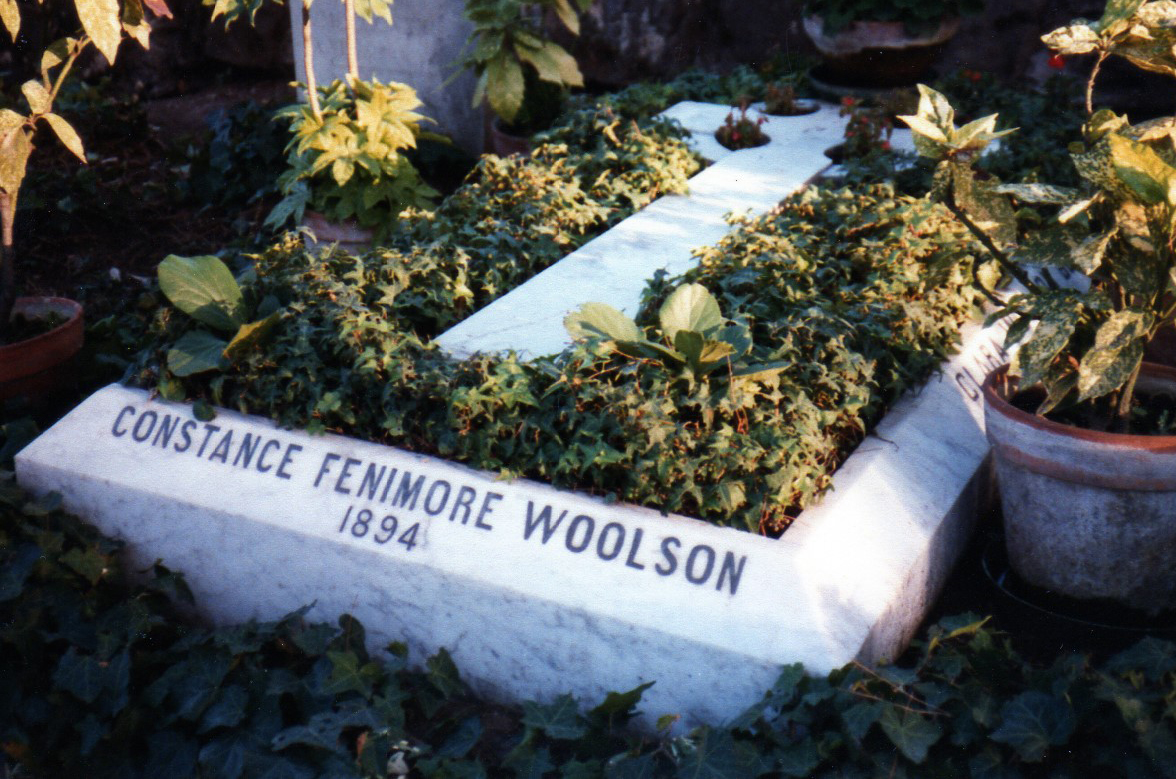
Protestant Cemetery, Rome
 Constance Fenimore Woolson